Endpoint security tools detect and block threats, but effective incident response also requires a reliable way to recover affected systems. A ransomware attack or failed system update can leave an endpoint unusable.
Keeping endpoints ready for recovery is ongoing work for teams managing thousands of endpoints. Administrators must keep backups on schedule, ensure organization-wide coverage, and coordinate restores across affected devices without adding more complexity.
Powered by MetaDefender™ Endpoint and My OPSWAT™ Central Management, OPSWAT’s Backup and Restore solution brings backup, recovery, and monitoring into one centralized workflow, using the same agent and console that support endpoint security and management.
Why Endpoint Backup and Recovery Remains a Persistent Challenge
A backup and recovery strategy supports incident response by enabling organizations to restore affected endpoints, reduce downtime, and maintain business continuity. However, managing backup and recovery processes across a large fleet of endpoints presents operational challenges.
Manual Recovery Breaks Down at Scale
Splunk’s The Hidden Costs of Downtime 2026 survey found that downtime costs each organization an average of $300 million per year, or more than $900,000 per hour. Endpoints go down for multiple reasons, including:
- Ransomware or destructive malware encrypts or wipes the device
- A faulty driver or update leaves the device unable to boot
- A configuration change breaks a working device
The usual fix is to manually rebuild the operating system, applications, configuration, and data. The workload increases when multiple endpoints require recovery across offices or remote locations, administrators must coordinate recovery while employees remain unable to access their systems.
Fragmented Tools Create Visibility Gaps
A standalone backup product adds more complexity, with another console to watch and another license to maintain alongside existing endpoint security operations. This pattern is common across security operations. The 2026 Thales Data Threat Report found that 77% of organizations use five or more data protection tools, yet only 39% are confident they understand what these tools do.
A backup that skips a device or a storage destination that fills up often goes unnoticed until an endpoint needs to be restored. Without visibility across all the organization’s endpoints, teams cannot confirm which endpoints have a current backup, which missed their last run, or provide auditable proof to support compliance.
Audit Requirement and Compliance Mandate
For many organizations, backup and restore operations have become necessary as part of their compliance requirements. A growing set of security frameworks and industry standards now require documented, tested backups and restore capabilities, including NIST SP 800, ISO 22301, ISO 27001, NIS2, and GDPR.
Auditors increasingly expect proof that data can actually be recovered, such as clear policies, defined recovery objectives, regular restore testing, and records showing that backups are protected from tampering or corruption. Organizations that can’t produce this evidence risk non-compliance, failed audits, and fines.
When a ransomware attack, system failure, or data loss happens, regulators look at how quickly and reliably the organization restored operations and protected sensitive data. An untested or compromised backup can turn a recoverable incident into a compliance violation. Backup and restore operations need to be verified, repeatable, and able to show clearly that critical data and systems can be brought back safely.
Simplify Endpoint Protection and Recovery with an All-in-One Agent
Closing these gaps starts with reducing the number of tools that teams need to deploy and monitor. MetaDefender™ Endpoint is an all-in-one solution that brings threat prevention, compliance, patch management, and endpoint recovery together. On every managed device, MetaDefender Endpoint helps:
- Detect and block threats with multiple anti-malware engines
- Detect vulnerabilities and enable automatic patching across operating systems, 1000+ third-party applications, and endpoints’ BIOS, and drivers
- Check device compliance against security policies and controls before access is granted
- Prevent peripheral and removable media threats by actively scanning removable media upon insertion and ensuring that only clean devices or content can be accessed
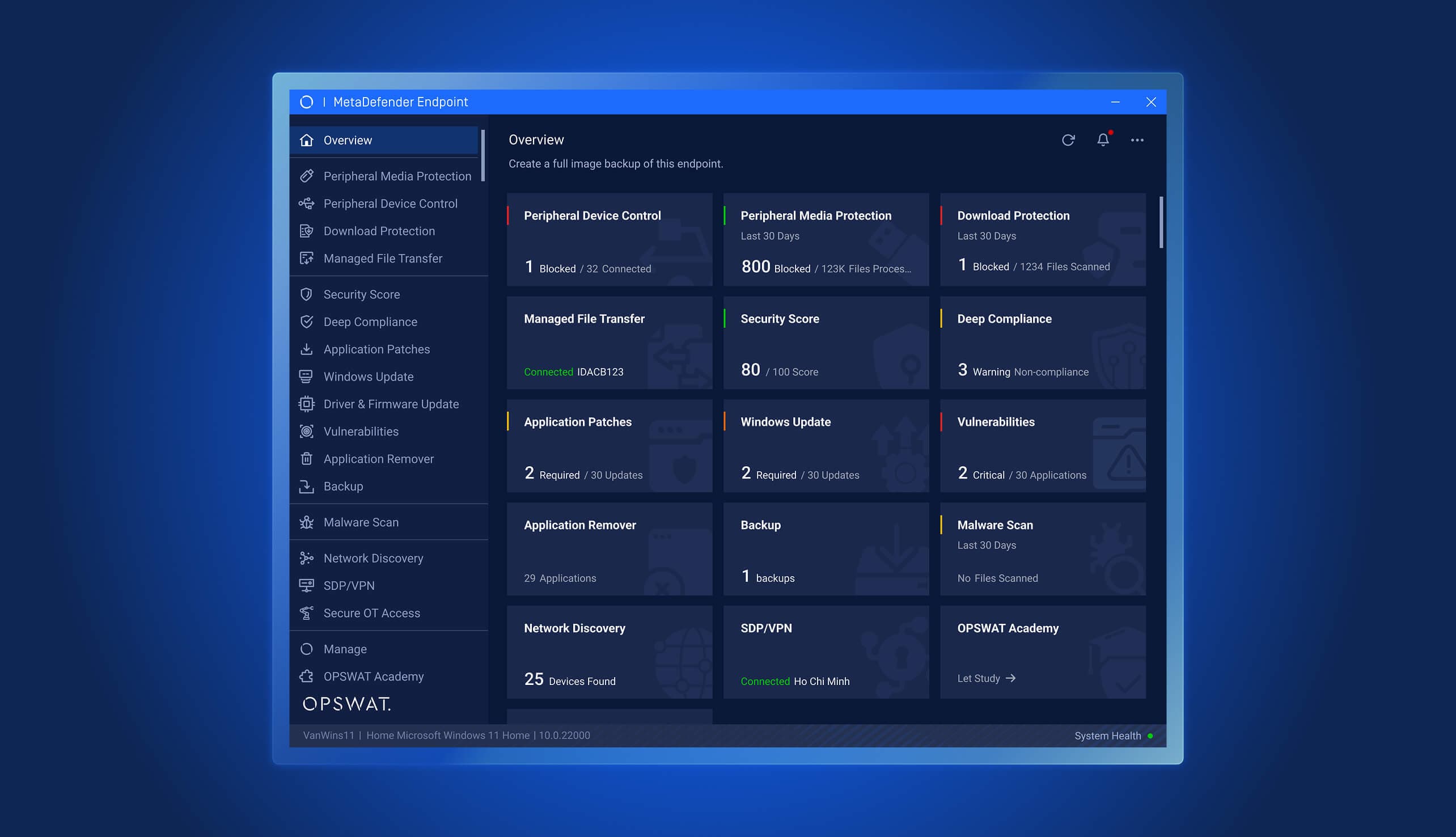
Backup and Restore extends this same agent with endpoint recovery. Teams do not need to deploy or maintain a separate backup product, applying protection and recovery side by side. This gives administrators a single source of truth for each endpoint’s security posture and recovery readiness. They no longer have to piece that view together from disconnected consoles.
Manage Endpoint Backup and Recovery from One Console
Endpoint recovery requires consistent backups and visibility, as well as a reliable way to restore affected systems without relying on manual, per-device coordination. OPSWAT Backup and Restore consolidates these activities into a single centralized workflow through My OPSWAT™ Central Management. From a single console, administrators can schedule backups, monitor protection across managed endpoints, and coordinate restores when devices need recovery.
Automate Backups Across Managed Endpoints
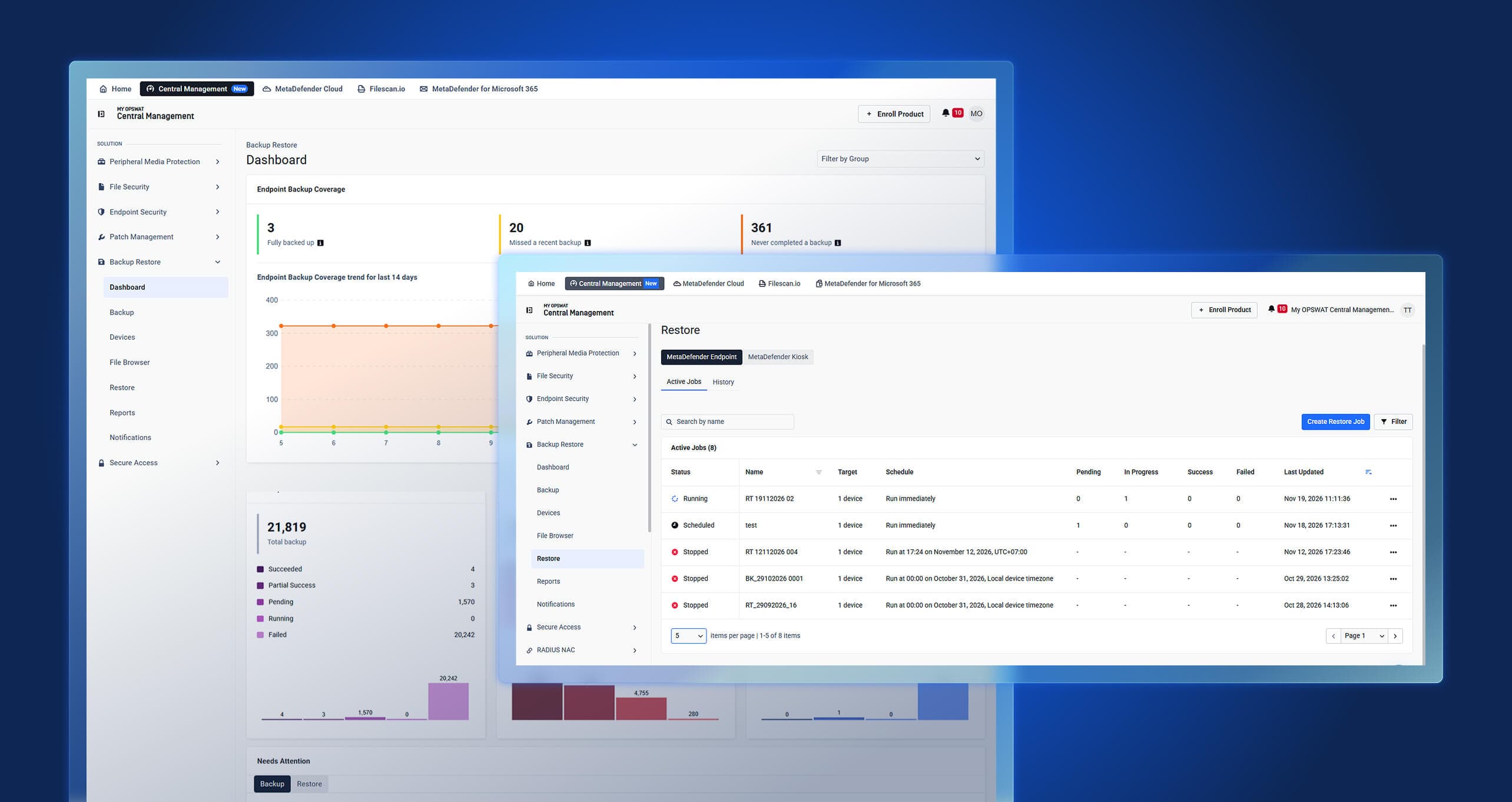
Administrators can apply backup jobs to all endpoints and schedule them to run hourly, daily, or monthly. The result is a consistent, automated backup routine rather than one that relies on manual follow-up across dozens or hundreds of devices.
Maintain Visibility into Backup Coverage Across Endpoints
A centralized dashboard brings backup coverage, job outcomes, failure reasons, and devices needing attention into one view. This allows administrators to identify endpoints with missed or unsuccessful backups, prioritize failures that put recovery at risk, and communicate backup status more clearly to management.
Restore Endpoints with Flexible Recovery Options
When one or more endpoints need to be restored, administrators can remotely schedule recovery through My OPSWAT Central Management. Each restore returns the device to a specific point in time, providing a predictable recovery path rather than an open-ended rebuild. If an endpoint becomes unbootable, the entire system can be recovered through bare-metal recovery.
Prove Recovery Readiness to Auditors
Every backup and restore run is recorded device by device, giving administrators a complete history of recovery activity. Scheduled reports can be generated in PDF or CSV format and automatically sent to stakeholders. Administrators can produce what leadership and auditors need from the same console they use to manage endpoint security.
Centrally Manage Backup and Restore Across Endpoints
OPSWAT’s Backup and Restore gives you centralized control over endpoint recovery from the same agent and console that protect your endpoints. Talk to our expert today to learn how endpoint recovery supports your business continuity.